Incognito - The Secret Lives of the Brain
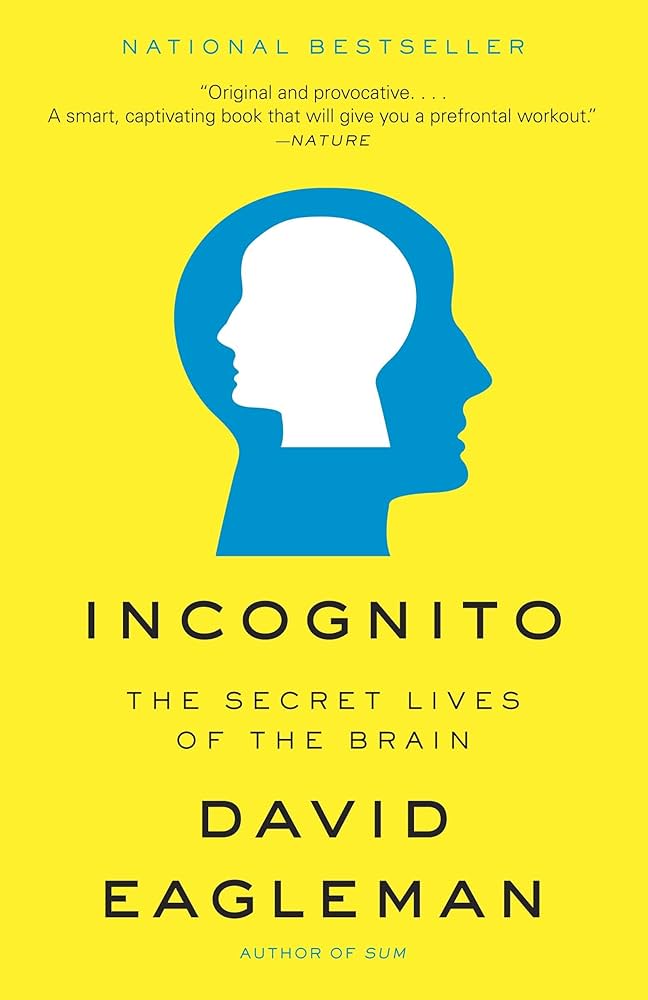
David Eagleman’s Incognito: The Secret Lives of the Brain dives into the vast, unseen workings of the mind—those countless processes that shape our reality without ever crossing into consciousness. What we think of as “ourselves” is just the tip of a neurological iceberg.
Consciousness as Headlines
Eagleman compares consciousness to a newspaper’s front page: condensed, simplified headlines, not the full story. The brain filters and compresses the flood of sensory and internal activity, letting through only what’s deemed essential for decision-making.
The Illusions of Seeing
We believe we’re taking in a rich, continuous 3D scene, but in truth, vision is an economical process. The brain doesn’t store every detail—it searches for the information it needs, filling gaps with assumptions. Our perception is guided not just by signals, but by expectations.
Priors and Perception
What we see isn’t raw input; it’s an inference shaped by prior experience. This raises questions: how are those priors learned? What happens when they’re wrong? Our perception is always an estimate, never the world itself.
Motion, Position, and Expectations
The brain processes motion and position separately, sometimes creating illusions like the waterfall effect. And top-down signals—our expectations—play a stronger role in shaping perception than bottom-up inputs.
Causality and Time
To perceive causality, the brain relies on the ordering of events. Without time, cause and effect would be impossible to discern.
Practice and Rewiring
When learning a new skill, consciousness is heavily involved. Over time, the brain rewires itself for efficiency, automating the behavior. Ironically, conscious interference—like overthinking a golf swing—can make performance worse.
The Limits of Perception
Eagleman writes about umwelt, the idea that each species (including humans) perceives only a slice of reality. We see visible light but miss much of the spectrum. We can’t imagine another creature’s perceptual world—only the loss of our own senses.
Oddities of Vision and Behavior
- We tend to briefly overrate the attractiveness of strangers glimpsed in passing—an evolutionary gamble favoring taking chances rather than missing out on a potential mate.
- Animals, too, run on “zombie behaviors.” Birds, for instance, may show contradictory instincts when presented with unnatural stimuli. Eagleman suggests that greater consciousness reduces these conflicts.
The Brain as a Team of Rivals
Rather than a unified commander, the brain resembles competing factions. Different modules battle for control, and whichever wins dictates behavior.
Free Will and Responsibility
If all brain activity arises from interacting networks, free will becomes elusive. Eagleman argues that dividing crimes into “voluntary” versus “involuntary” is flawed—both ultimately result from biological processes outside conscious control. What makes a behaviour “voluntary” compared to “involuntary” is just that we can explain the biological mechanism for the involuntary behaviour and attribute the voluntary behaviour to the mysterious free will.
Rethinking Criminal Justice
Since many criminals act from impulsivity rather than ignorance of right and wrong, rehabilitation should focus on training the prefrontal cortex—the seat of self-control—rather than punishment. The goal: change future behavior, not exact retribution.
Reductionism and Identity
There’s no immaterial soul outside the brain. Who we are—our memories, personality, choices—exists in neural tissue. When the brain changes, so do we.
Genes, Environment, and Complexity
Few traits boil down to a single gene. Most result from complex interactions between multiple genes and environmental influences. Nature and nurture are inextricably entangled.
Eagleman’s central message is both humbling and liberating: the conscious “I” is a sliver of a much larger, stranger system. By understanding the brain’s hidden machinery, we not only learn who we are, but also rethink how we judge others, design justice, and expand our perception of reality.